Hangzhou is the capital of Zhejiang province and its political, economic and cultural center. With its famous natural beauty and cultural heritages, Hangzhou is one of China's most important tourist venues.The City, the southern terminus of the Grand Canal, is located on the lower reaches of the Qiantang River in southeast China, a superior position in the Yangtze Delta and only 180 kilometers from Shanghai.
Knowing Hangzhou
Honours
The Best Tourism City of China jointly certificated by the United Nations World Tourism Organization and National Tourism Administration, 2006 UN-Habitat Scroll of Honour Awards Winner certificated by the United Nations Human Settlements Programme, 2001 International Garden City certificated by International Federation of Parks and Recreation Administration, 2002 Best Investment Environment Cities of China certificated by the World Bank (2004, '05, '06, '07, 08) Forbes Top Cities for Doing Business on the Chinese Mainland (2004, '05, '06, '07, '08) Oriental Outlook China's Happiest City (2004, '05, '06, '07, '08) CCTV A Famous Chinese City That Should Be Introduced to the World, 2008
City Symbol
The symbol of Hangzhou is filled with meaning. It is the artistic form of the Chinese character Hang (as in Hangzhou) inscribed as a Chinese seal character. It integrates a boat, town, structure, gardening and an arched bridge symbolizing this water-based city. The symbol, with a silhouette featuring the Three Pools Mirroring the Moon (one of Hangzhou's famous scenic sites) on its right side, vividly portrays the flavour of Hangzhou's South China culture.
City Tree and Flower
The camphor tree (of East Asia) and osmanthus flower, two kinds of sweet plants, were chosen as the city tree and flower by Hangzhou's residents. Appreciated for its aesthetic appeal in gardening, the camphor tree was important in the practice of fengshui and in commemorating ancestors in ancient Chinese culture; it symbolizes long life and happiness. Planting osmanthus flowers in Hangzhou has a history of nearly 1,000 years, with the flowers of Manjuelong the most famous. "Sweet Osmanthus Rain at Manjuelong Village" is considered one of the "New Top Ten Sceneries of West Lake."
Hangzhou is a modern city in a classic Chinese setting. The city hums with activities and an endless flow of traffic, signs of its place in the 21st century, while the beautiful West Lake lies peacefully at the heart of all commotion, soothing the senses.
In eastern China, Hangzhou is the capital of Zhejiang Province and one of the seven capitals of ancient China. The city is also the southern end of the Beijing-Hangzhou Grand Canal, the longest canal ever built in the world. Find out more about the city’s history which dates back 5,000 years, or immerse yourself in the cultural heritage by sitting back and relaxing with a cup of exquisite West Lake Longjing Tea.
Brief history
Hangzhou's history dates back to 2,200 years ago during the Qin dynasty (221-206 BC), but the ancient Liangzhu people inhabited the area more than 5,000 years ago. During the Five Dynasties and Ten Kingdoms Period (907-979 AD), the city was chosen as capital of the Wuyue Kingdom. It later became the capital of the Southern Song Dynasty (1127-1279 AD) when the central government fled from its original capital in Kaifeng after it fell to the invading Jurchen tribes of the Jin Dynasty from northeast China.
The Jurchens are not the same as Han Chinese and were viewed by the ancient Chinese as foreigners and barbaric since they lived a nomadic life. Under the Sui Dynasty (581-618 AD), Hangzhou became the southern terminal of the Beijing-Hangzhou Grand Canal to transport food from southern China, where agricultural fields are mostly located, to the north.
Through the years, the city has grown into a prosperous metropolis known for its scenery, graced by ancient literary writers and the final resting place of household historical figures. Today, it continues to strive towards the conservation of its natural heritage, a daunting task in an era where modernity often takes precedence, especially so in a fast a developing country.
Accommodation As a city with scenic tourist destinations and a rich cultural heritage, there are many hotels within the heart of the city. Hotels are normally near the West Lake, at major shopping and food districts. They provide modern accommodations ranging from basic to luxurious and it is usually easy to find available rooms at any hotels.
Luxury Hotels Luxury hotels such as Shangri-La, Hyatt Regency, and Zhejiang Narada Grande (formerly known as Zhejiang World Trade Center Hotel) provide world-class facilities and services ranging from complimentary broadband Internet access, car and bicycle rental, to beauty and child care. They enjoy an ideal location near West Lake and within the heart of shopping and business districts.
Shangri-la and Hyatt Regency offer rooms with a splendid view of West Lake, and are perfect for couples as a romantic getaway or for business travelers to relax in the scenic tranquility. They are beautifully furnished with an elegant ambience. On the other hand, Zhejiang Narada Grande has been listed as one of the “Top Ten New Sights of Hangzhou Urban Architecture”. Exquisitely designed, the hotel revels in classic Chinese architecture with styles inspired by the late Ming Dynasty and early Qing Dynasty. Chinese calligraphies and paintings adorn the walls of the hotel, allowing visitors to appreciate ancient Chinese art.
China’s most picturesque setting, Four Seasons reveals an intimate lakeside village, melding centuries of tradition with chic contemporary style. Convenient to business and shopping, discover a tranquil enclave, woven with ponds, streams and lagoons. Experience the gentle spirit of Chinese hospitality in exclusive private dining rooms and resort-style recreation, including two swimming pools and a cutting-edge designer spa. Deftly sophisticated Four Seasons care instills confidence and delight.
The Wyndham Grand Plaza Royale Hangzhou (Hangzhou Xihu Wendemu Zhizunhaoting Dajiudian) is located at the intersection of West Huancheng Road and Fengqi Road, within easy reach of Hubin and Wulin commercial areas. Only a five-minute walk sees guests to Hangzhou's best known attraction West Lake.
On offer of this Hangzhou hotel are various guestrooms such as lake-view rooms, non-smoking rooms, handicapped-friendly rooms and specially-designated ladies' rooms, all outfitted with sightseeing balconies, 24-hour hot water, 37-inch LCD TVs and high-speed wireless internet access.
At the on-site restaurants guests can enjoy both Chinese and Western cuisines. There are seven well-equipped conference rooms available for booking, seating from 20 to 500 guests. In addition, guests will find a unique outdoor garden and balcony, a special venue for meeting and wedding.
Standard hotels Though they do not enjoy the glamorous reputation of internationally renowned hotels, four-star standard hotels such as Hangzhou Xinqiao Hotel (Xinqiao Fandian), Zhijiang Hotel and Hangzhou Hotel provide excellent accommodations that meet the needs of a regular traveler. They reside within the city’s main districts and are usually a stone’s throw away from West Lake. Rooms are comfortably furnished; there are constant warm showers, and the hotels boast elegant banquet halls with continental breakfasts. The hotels also feature lavish restaurants that offer Zhejiang specialties, Cantonese dishes and fresh international seafood.
Hostels Warm and snuggly, the Hangzhou International Youth Hostel (Ming Tang) is a place where guests are welcomed with vibrant smiles while relaxing in a comfortable environment. There are two types of rooms, ensuites and mixed dorms: the ensuites are designed and furnished with Ming and Qing dynasty styles, come with personal toilets and a private classical Chinese balcony; while the mixed dorms are homely with a locker, bookshelf and reading lamp for every bed. There are also water dispensers at hallways, security doors, laundry room, a self-service kitchen with a view of West Lake and an open balcony garden where guests can have their meals in spring and summer. As such, the hostel’s logo Ming Tang is inspired by the grand halls of the Ming dynasty, where guests are warmly welcomed and attended to.
A café and bar with wooden panels and country furnishings create a soothing ambience where guests can enjoy jazz music and idle conversations. Such an atmosphere must definitely be accompanied with fine imported liquor and cocktails served at the bar while the café offers delicious meals, pastries, sandwiches and drinks. At the end of the café, dimly lit lamps and soft cushions serve as a cozy, quiet corner for guests to relax after a long day. At the reception area, guests are allowed to use the Internet booths free or simply get connected through the free Wi-Fi service in the café. English books are also available for browsing and a billiard table sllows guests to mingle and play. Services at the hostel include warm showers within certain times, luggage storage, 24-hour reception, towels, paid shuttle buses from hostel to bus, airport and train stations, and cab call service. If you do not know how to get to the hostel upon arrival in Hangzhou, do give them a call for directions.
Accommodation As a city with scenic tourist destinations and a rich cultural heritage, there are many hotels within the heart of the city. Hotels are normally near the West Lake, at major shopping and food districts. They provide modern accommodations ranging from basic to luxurious and it is usually easy to find available rooms at any hotels.
Luxury Hotels Luxury hotels such as Shangri-La, Hyatt Regency, and Zhejiang Narada Grande (formerly known as Zhejiang World Trade Center Hotel) provide world-class facilities and services ranging from complimentary broadband Internet access, car and bicycle rental, to beauty and child care. They enjoy an ideal location near West Lake and within the heart of shopping and business districts.
Shangri-la and Hyatt Regency offer rooms with a splendid view of West Lake, and are perfect for couples as a romantic getaway or for business travelers to relax in the scenic tranquility. They are beautifully furnished with an elegant ambience. On the other hand, Zhejiang Narada Grande has been listed as one of the “Top Ten New Sights of Hangzhou Urban Architecture”. Exquisitely designed, the hotel revels in classic Chinese architecture with styles inspired by the late Ming Dynasty and early Qing Dynasty. Chinese calligraphies and paintings adorn the walls of the hotel, allowing visitors to appreciate ancient Chinese art.
Standard hotels Though they do not enjoy the glamorous reputation of internationally renowned hotels, four-star standard hotels such as Hangzhou Xinqiao Hotel (Xinqiao Fandian), Zhijiang Hotel and Hangzhou Hotel provide excellent accommodations that meet the needs of a regular traveler. They reside within the city’s main districts and are usually a stone’s throw away from West Lake. Rooms are comfortably furnished; there are constant warm showers, and the hotels boast elegant banquet halls with continental breakfasts. The hotels also feature lavish restaurants that offer Zhejiang specialties, Cantonese dishes and fresh international seafood.
Hostels Warm and snuggly, the Hangzhou International Youth Hostel (Ming Tang) is a place where guests are welcomed with vibrant smiles while relaxing in a comfortable environment. There are two types of rooms, ensuites and mixed dorms: the ensuites are designed and furnished with Ming and Qing dynasty styles, come with personal toilets and a private classical Chinese balcony; while the mixed dorms are homely with a locker, bookshelf and reading lamp for every bed. There are also water dispensers at hallways, security doors, laundry room, a self-service kitchen with a view of West Lake and an open balcony garden where guests can have their meals in spring and summer. As such, the hostel’s logo Ming Tang is inspired by the grand halls of the Ming dynasty, where guests are warmly welcomed and attended to.
A café and bar with wooden panels and country furnishings create a soothing ambience where guests can enjoy jazz music and idle conversations. Such an atmosphere must definitely be accompanied with fine imported liquor and cocktails served at the bar while the café offers delicious meals, pastries, sandwiches and drinks. At the end of the café, dimly lit lamps and soft cushions serve as a cozy, quiet corner for guests to relax after a long day. At the reception area, guests are allowed to use the Internet booths free or simply get connected through the free Wi-Fi service in the café. English books are also available for browsing and a billiard table sllows guests to mingle and play. Services at the hostel include warm showers within certain times, luggage storage, 24-hour reception, towels, paid shuttle buses from hostel to bus, airport and train stations, and cab call service. If you do not know how to get to the hostel upon arrival in Hangzhou, do give them a call for directions.
Dining
Hangzhou Popular Dishes and Specialties (what to eat in Hangzhou)
Typical dish of Hangzhou cuisine are many traditional homely dishes and reminiscent flavors like West Lake Fish in Vinegar Gravy, Braised Dongpo Pork, Beggar"s Chicken, Longjing Shrimp and Hangzhou Soy-sauce Duck. These traditional and reminiscent dishes are regarded by Hangzhou locals as "Cuisine of Mom".
West Lake Fish in Vinegar Gravy The lake, the canals and the nearby ocean guarantee fish, shrimp and other seafood as staples in the cuisine. Perhaps the most famous fish dish of Hangzhou cooking is West Lake Fish in Vinegar Gravy. In this dish, a fresh alive grass carp is firstly kept hungry in clear water for one to two days to rinse well, and then it is cut in half from head to tail but not separated, delicately poached and then served eyes-up and topped with a sharp sweet and sour, vinegar-based sauce. This dish integrates delicious tastes, with tender fish meat like crabmeat.
Hangzhou Soy-sauce Duck Hangzhou soy-sauce duck is a type of marinated duck. It is the typical flavor and adopted the traditional methods of the folk. The ducks are chosen from those stout and strong and good ones, and then are pickled and topped with soy-sauce. Well processed ducks usually in the bordeaux color are fragrant. They taste a bit salt and tiny sweet.
Beggar"s Chicken The beggar"s chicken is a traditional Chinese, especially Hangzhou, as popular with tourists as with far eastern gourmets. Main materials of this dish call for a chicken, leaves and pond mud. When the chicken is packed with delicate fillings, it is the lotus leaf and mud wrapping that makes this chicken so tasty, tender and intriguing. Beggar"s Chicken has interesting stories just like other typical dishes of Hangzhou. The legend about the beggar"s chicken is a Hangzhou thief invented it. As he had no stove, he wrapped the stolen bird in clay and baked in a hole in the ground. Then the taste of this chicken is so charming that the cooking methods went round widely from then on.
Braised Pork Belly or Dongpo Pork Dongpo Pork is a specialty of Hangzhou with very crispy outside. The name "Dong po" comes from the medieval Chinese poet, who was named Su Dongpo. Dongpo Rou (Chinese pronunciation) refers to braised pork belly. It is usually served as a 2 inch cube of pork in individual clay lidded pot. Being braised with soy and sugar and spices, it is very soft and juicy, and also very tasty. One of the special flavorings in Braised Dongpo Pork is Shaoxing Wine – a kind of yellow rice wine. It also needs take at least 4 hours to get the best results when making Dongpo Pork. It is done when the fat, skin, and meat are easily pierced with blunt chopsticks. At this time Dongpo Pork is red and bright in color, oily but not greasy, crisp but not smashed, plus mellow juice. It is usually served with plain rice or steamed buns and accompany with some greens or vegetables.
Longjing Xia Ren or Dragon Well Tea Shrimp Longjing Xiaren is fried shrimp in Longjing tea. People in Hangzhou cooked the fresh shrimp with characteristics: fresh and special taste and faint scent. The shrimps after rinsed should be marinated in a tablespoon of Shaoxing wine (a kind or yellow rice wine usually used in cooking). By the same time the Longjing tea leaves should be brewed in boiling / hot water and then they will expand to huge leaves, and you need to keep the tea to use in stir-frying. It is famous for infused with the aromatic and high priced Longjing tea and this dish pleases people"s palate with lingering fragrance of the tea and the crunchy texture of the shrimp.
Famous Restaurants
Louwailou Restaurant
Built in the 1840s by a Qing Dynasty Noble, Louwailou Restaurant is said to be the oldest restaurant in China. Many foreign VIPs have dined there while visiting Hangzhou. The Restaurant features authentic Hangzhou cuisine. Tasty foods served include West Lake Carp in Sweet and Sour Sauce, Beggar's Chicken, as well as Dragon Well Tea served with snacks.
Other Hangzhou specialties include Stewed Duck with Dried Bamboo Shoots, Crab Stewed with Spiced Leaves, yutiao or fried dough sticks, Hangzhou Noodles with Pork and Bamboo Shoot, Long Jin tea leaves cooked with shrimps, braised fish soup, West Lake fish in vinegar sauce, etc.
Not to forget, a wonderful dining experience must be followed by good beers such as Tsingdao and West Lake beer (Xihu jiu 西湖酒).
ZhiWeiGuan (知味观): As a saying regarding this old reputable restaurant goes, “the aroma is so luring that visitors stop in their tracks to have a look” (zhi wei ting che, wen kan xia ma知味停车,闻香下马). ZhiWeiGuan specializes in creating avant-garde dishes unique to the restaurant and is a perfect place to go if you are looking for something fun and interesting.
Green Tea Restaurant (绿茶): Made of wooden stilts and thatched roofs, this restaurant offers guests a refreshing getaway from city life with its traditional setting and modern amenities. It has house specialties such as barbequed prawns, exquisite Longjing Tea and spicy peppered fish with a fresh flavor.
- Address: 83 Longjing Road, near the China National Tea Museum. - Opening hours: 11am-1am; 10.30am-2am on weekends and public
Shopping
Hangzhou, a Chinese Southern City offers a superb collection of local crafts, rare arts and other souvenirs. Hangzhou Silk, Hangzhou Embroidery, West Lake Silk Umbrellas, Tianzhu Bamboo Chopsticks, as well as White Chrysanthemum Tea and world-famous Longjing Tea are typical Hangzhou specialties and souvenirs. Hangzhou has a great outdoor silk market called the China Silk City (Zhongguo Sichou Cheng) on Fengqi Lu that runs for two blocks.
Shopping Areas in Hangzhou
(I) Hangzhou Markets
Hangzhou Silk City
Location: It is located at No.253 Xinhua Road (at the intersection of Fengqi Road, Tiyuchang Road, and Xinhua Road) Bus No.11 and 28 available to arrive there..
It is the best place for purchasing silk and the biggest silk wholesale and retail market in China with more than 600 silk enterprises dealing in a wide variety of pure silk fabrics, garments, handicraft articles, scarves, and ties. The shoppers there not only do business on the mainland, but also export their silk products to Europe, America, Australia, Hong Kong, Macau, and Taiwan. The market is distinguished as offering standardized management, reliable quality, and reasonable prices.
Meijiawu Village in Hangzhou
Location: in West Lake District
If you are interested in buying Longjing tea, there are several tea shops at the Meijiawu tea village. Throughout history, Longjing tea has been well known for its fresh taste and fragrance. Later, it was found to contain vitamin C, amino acids as well as a high concentration of catechins. With such health benefits, the Longjing tea is a favorite among many Chinese, and is one of the treasured teas in China, usually offered to government officials during events or ceremonies. The best leaves are normally in late March and early April, when the leaves are first harvested.
Enjoying a famous long history, Hangzhou Longjing Tea (Dragon Well Tea) is famous for its unique green color, fragrant aroma, sweet taste, and flat appearance, also regarded as a health elixir. If you are interested in tea culture and history, hereis the ideal spot where you can watch a tea ceremony, and select tea under professional guidance.
Cultural Shoppingg
Qinghefang Street
It is one of the most famous historic streets in Hangzhou, Most preserved buildings are from the Ming and Qing dynasties. Strolling on this street, you will be attracted by the antique buildings and local crafts, such as silk parasols, brocades, noted Zhang Xiaoquan scissors and Hangzhou fans.
Visitors walking along the street will also be attracted to the local handicrafts such as having clay figurines of your image made in fifteen minutes, zisha or earthenware teapots with ornamental hand cravings and glass bottles with Chinese paintings painted on the inside. Zisha or clay earthenware is widely used in China to brew and serve mostly black tea, Oolong tea and Pu Er tea. Its first use dates back to as early as the Song dynasty. During brewing, the teapot absorbs a tiny amount of tea and prolonged usage of it eventually retains the flavor of the tea. Zisha teapots are also valued in the market for their exquisite handicrafts since it takes years of practice to produce a teapot of fine quality that ensures a smooth control of tea during pouring. The art of painting from the inside of a glass bottles is also another craft that takes patience and time. Visitors will be intrigued by the lovely Chinese paintings of pandas, mountains and flowers painted skillfully on the interior of the glass bottles by artists using delicate, tiny brushes. As such, Hefang Street is a perfect place to buy unique handicrafts as souvenirs.
Hangzhou Silk City at 253 Xinhua Road, near Fengqi road is an ideal place to shop for silk products. There are more than 600 shops carrying a wide range of silk, from fabrics to clothing, bags, shoes, handicrafts and so on. Many of these shops also export to countries worldwide and the market is known for its fine quality and reasonable prices.
According to folklore, silk was discovered by Empress Leizu, wife of the legendary Yellow Emperor or Huangdi. It is not known if the reign of Huangdi really existed but it is said that he ruled from 2697 BC to 2597 BC. As the story goes, Empress Leizu and Huangdi lived during a time when clothes were still made out of animal skins. One day, while taking a walk in her garden, Leizu noticed some silkworms feeding on the leaves of the mulberry trees in the garden and spinning cocoons that seemed to be made up of fine threads. She took one cocoon home and dropped it into a pot of boiling water whereby a fine thread started to unwind from it. Upon closer examination, Leizu realized that she could unwind the thread continuously from the cocoon and decided to collect several more samples. Day and night, she worked and experimented till she succeeded in spinning and weaving garments from it. Realizing that this would provide clothing for the people, Leizu persuaded her husband to grant her a trove of mulberry trees where she could rear silkworms and went on to invent the first silk reel and silk weaving loom. From then on, the people did not have to rely on animal skins as clothing and Leizu has since been revered as the founder of silk.
Modern Shoppingg
The major shopping streets are Jiefang Road, Yan’an Road and Wulin Gate/Square, Wushan Square. Luxurious brand such as Hermes, Versace and Giorgio Armani can be found near the West Lake. Shops such as Vero Moda, Only and Adidas are also located nearby. Wulin Road is every female’s paradise where stores carrying female fashions line the street.
The entire Yan’an Road is a common shopping area. There are two squares at the two end of the road, and many small stores are on the road between the two squares.
Wulin Square: At the northern end of Yan’an Road and surrounded by several large stores -- Hangzhou Tower, Hangzhou Department Store, In Time Department store (Wulin Square Branch), and GDA Palaza. This is a shopping paradise for every female as shops here carry a wide variety of ladies’ style and fashion.
Wushan Square: At the southern end of Yan’an Road. There are also several big store such as Hangzhou Jieba Department Store, In Time Department store (West Lake Branch), Yuanhua Department Store.
Jiefang Road
Jiefang Road, traversing the downtown of Hangzhou, is another traffic artery in Hangzhou, connecting East City Ring Road with the intersection of Nanshan Road and Hubin Road. Scond only to Yan'an Road, it is the also an important business street, and a wonderful place to pan out your favorite goods. On May 3rd 1949, the road got its name and started its life. Many old-established shops can be found here, such as Hengdeli Clock & Watch, Maoyuancang Glasses, Zhangxiaoquan Scissors, Zhiweiguan Restaurant and so on. All these old shops compete with each other in order to get survived in Jiefang Road. Moreover, some new brands are unwillingly to be outdone and begin to burgeon. Nevertheless, the sports franchised stores like Nike, X-Tep, Jeanswest etc. have shown the vibrant view of Jiefang Road and attracted more people here.
Yan'an Road
Yan'an Road is called "Hangzhou First Street", intersected with Kaiyuan Road, Jiefang Road, Pinghai Road, Qingchun Road and Fengqi Road, in a length of 3405. It is a traffic artery and at present the busiest shopping street in Hangzhou. Along the street there is Provincial Great Hall of People, Menglianglou Restaurant, Nanfang Restaurant, International Department, Hangzhou Department Store and many other commercial centers and entertainment venues. The South part targets at young people with many leisure apparel brands.
Joining up with Wulin female fashion street, the north part of Yan'an Road not only displays other worth-buying clothes, but also forms a unique style of leisure and fashion. Wulin Square is at the end of the north of Yan'an Road, where lots of big business centers are located, namely Hangzhou mansion. Wulin Square is favored by businessmen and the local citizens.
Entertainment
Nightlife
When evening falls, Hangzhou’s pubs and clubs surface to make up the city’s nightlife. Hitting a bar or a pub would be a great idea after a day out as a sip of wine while relaxing to jazz music will end the day on a perfect note. Pubs in Hangzhou are vibrant and packed with an international community gathering to chill out, while the tea houses are tranquil with a pleasant environment that allows one to sit back and savor various kinds of coffee and tea.
Try out JZ Club or Huanglou (黄楼) which is one of Hangzhou’s popular pubs with live foreign performances almost every night. Modern and laidback, the tables are set with tea lights for a soft relaxing atmosphere where guests can settle in the armchairs and exchange idle conversations. A variety of performances ranging from jazz, soul, instrumental and R&B are put up by foreign artistes every night. The pub serves menu consisting of mock tails, cocktails, fine imported liquor and wine, special house mixes and snacks. Guests, who are staying for more than one night in Hangzhou, can purchase a bottle of imported liquor at the pub where it will be kept and served to you whenever you pay your next visit.
Designed by internationally known Canadian architect Carlos Ott and opened in 2004, Hangzhou Grand Theatre covers 100,000 square meters with a total construction area of 55,000 square meters. It consists of an opera house, a concert hall, a multifunction hall, an open-air stage and a culture square. An impressive program of Western classical and traditional Chinese music is planned for 2007 and 2008.
Hangzhou Comic Art Theater (Hangzhou huaji yishu juyuan)
12 Guxin Lu, Hangzhou
0571-8806 5625
Hangzhou Comic Art Theater was established in October 1950. It has created and performed many influential modern plays and comedies. Locals and expats love to come to this theater for a bit of comic relief. Non-Chinese speaking travelers coming to the theater will have a double-joy watching the production as well as the audience's reaction. The theater is reputed for producing some of the best stories including "Don't Cry, Mum" (Ma Ma,Ni Bu Yao Ku) a story about the different results caused by different educational methods in two stereotypical Chinese families. The story symbolizes a social phenomenon, which makes people reflect on the absurdity of things that may consider menial, but have a great impact, and "Happy Family" (Huan Le Ren Jia), a wonderful story with a moral message on treatment of the elderly and family members.
Bars:
Before you hop into the discotheques and nightclubs a visit to the Bars and Pubs in Hangzhou will definitely set a perfect mood for the same. You would definitely love to swallow down a few bottles of beer in the splendid ambience of Hangzhou’s Bars and Pubs before you set the floor on fire.
- Reggae Bar - Close to the Zhejiang University the Reggae Bar at 95 ShuGuang Lu, Hangzhou, China is the one that mainly attracts the college youth. This crowd taps their toes with the beats of the hip hop and rock music played by DJs. With imported beers, light food like pizzas, fries and burgers and the happy crowd this bar greets its customers with warmth.
- Shamrock Irish Pub - The Shamrock Irish Pub in Wushan Square at the 89 Jiefang Road (Junction of Jiefang Rd. and Jianguo Rd.), Hangzhou, China is set in a historic structure that of the Ming Dynasty of the early 1900s. The casually dressed mixed crowd in the bar always has a wide option for selection between British beers, wine, sprits and Guinness. Live music of the bar sets a relaxed, casual and fun filled atmosphere.
- The Hong Fang Bar at 24 South Yan An Road) Hangzhou, - The Meng Zhi Hu at No.103 Nanshan Road.
KTV:
Pinghai Mongkok KTV
12pm - 6am
4/F, Pinghai Wangjiao, 58 Pinghai Rd.
0571 8703 8777
Teahouse:
Men’er Teashous Address: 47 Shuguang Road, Bus: 28, 15, 16, K599 Business time: 10:00 AM - 2:00 AM(next day) Average annual consumption: 50 yuan
Qingteng Teahous Address: 53 Hubing Road, Bus: 25, 12 Business time: 9:00 AM - 2:00 AM(next day) Average annual consumption: 55 yuan
Xinyuan Teashous Address: 429 Tiyuchang Road, Bus: 11, 28, 155, K599, K555 Business time: 9:00 AM - 2:00 AM(next day) Average annual consumption: 55 yuan
Taotaoju Teahous Address: 619 Fengqi Road, Bus: 1, 10, 49, 25, 66, 199, 78, 102 Business time: 9:00 AM - 17:00 AM 17:00 AM - 2:00 AM(next day) Average annual consumption: 55 yuan
Impressionist West Lake
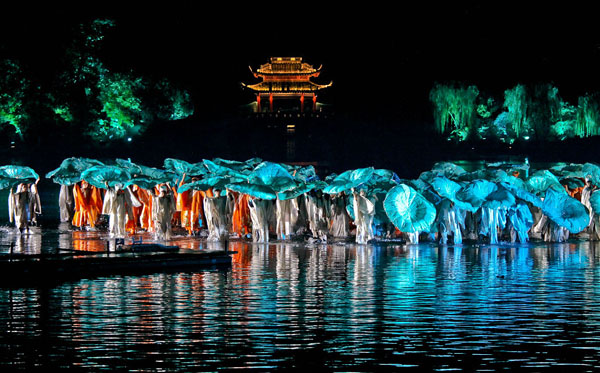
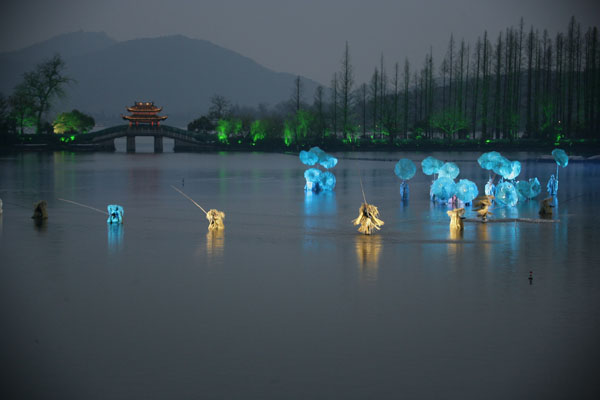
Produced by famed director, Zhang Yimou, Impressionist West Lake is a musical performance on the surface of the lake just across the road from Yue Fei Temple. With a play of lights, ancient costumes and melancholic music set in the beauty of the lake, performers play out the story of Madam White Snake on a stage partly immersed in the water. This not only gives the impression of dancers on the water surface instead of a visible solid platform, but also allows the use of water as a visual effect and a prop.
Staged entirely upon the lake itself (a stage has been built 3 centimeters below the surface), Impression West Lake is a world class spectacle of light, music, dance and theatrics. Using the lake and its surroundings as props, lights and hundreds of actors create a sensational performance.
Winter Break Guest who wants to book the show next year between January to February should enquire the show schedule through email in advance. Usually there will be a 2-month winter break for the Impression West Lake every year.
As the title suggests, the musical is meant to inspire imagination by giving audience a glimpse into the romantic legend of the lake. Like a piece of art where the strokes of an artist and nature blend to create a masterpiece, Impressionist West Lake leaves a lingering impression on the audience. Just like the couple who though belong to legend, remnants of their dreams and love gave West Lake an eternal nostalgic and melancholic beauty.
Note: Both the ticketing booth and the performance venue are just across the road, opposite Yue Fei Temple. Please be seated 30 minutes before the performance starts. If there is a light drizzle, the show will still resume as scheduled but please refrain from using umbrellas. Rain coats or ponchos will be provided by the staff to the audience upon arrival. In the event of lightning or a thunderstorm, the show will be cancelled for safety reasons and tickets can be refunded within 3 days.
- Performance schedule: 1st show: 7.45pm-8.45pm. 2nd show: 9.15pm-10.15pm. - Prices: for normal seating, the price is 300 yuan per person; for VIP stand, the price per person is 450 yuan per person and for the grand stand, the price is 600 yuan per person. - Company address: No. 29 Yanggongdi